Is Your Heater Failing? What Frequent Cycling Actually Tells You
A furnace that fires up, runs for two minutes, shuts off, then starts again five minutes later doesn’t feel right. And that instinct isn’t wrong, it’s worth paying attention to. The harder part is figuring out whether you’re dealing with a genuine failing heater situation or something that sounds worse than it is.
That distinction matters because the fix is either a $10 filter or a conversation about replacement. Big gap.
What Short Cycling Actually Is
Short cycling is when the heater starts, runs briefly, shuts down, and repeats the cycle more often than it should. A healthy furnace typically runs 10 to 15 minutes per cycle on a cold day. Sometimes longer. When it cuts off after 2 or 3 minutes and restarts constantly, something is interrupting the process.
That interruption doesn’t automatically mean a heater is failing. Modern furnaces are built with safety switches that shut the system down when something looks off, high temperatures, ignition problems, or airflow restrictions. The shutdown itself is the system working correctly. The question is what’s triggering it.
Start With the Simple Stuff
Most service calls for frequent cycling don’t require any parts. They require basic troubleshooting that any homeowner can handle.
- Dirty air filter: This is the most common culprit. A clogged filter chokes airflow, heat builds up inside the cabinet, and the high-limit switch shuts the burner down before it overheats. The furnace cools off, then tries again. Swap the filter and the problem is often gone in minutes.
- Blocked vents: A vent closed off by furniture or a rug does the same thing. Restricted return or supply air causes the system to overheat internally, which triggers the same safety shutoff.
- Thermostat placement: A thermostat near a sunny window or a supply vent can read the room as warmer than it actually is. The heater gets cut off too early, the temperature drops, and the cycle starts again. Placement problems are easy to fix and often overlooked.
- Oversized furnace: This one surprises people. A furnace that’s too powerful for the square footage heats the space so quickly that the thermostat is satisfied almost immediately. The system shuts off, temps dip, and it fires right back up. Nothing’s broken, the system is just mismatched to the house.
Go through that list before calling anyone. More often than you’d expect, one of those is the answer.
When It Points to a Heater Failing Component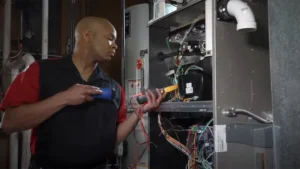
If the basics check out and the cycling continues, that’s when to start thinking about internal issues.
- Flame sensor failure: Flame sensor failure The flame sensor confirms that ignition actually happened. When it gets coated with residue which happens gradually over time, it can’t detect the flame reliably, so the gas valve shuts off as a safety measure even when combustion is working fine. Cleaning a flame sensor takes about five minutes. Ignoring it leads people to believe their heater is failing outright when a basic service call would’ve handled it.
- Blower motor problems: If the blower motor weakens and can’t move enough air across the heat exchanger, heat accumulates inside the system. The limit switch trips again. The heater stops, cools, and tries again. A struggling blower is a sign of a heater failing internally it puts stress on the entire system over time.
- Cracked heat exchanger: This is the scenario technicians don’t love bringing up. A compromised heat exchanger can cause overheating, improper combustion, and repeated safety shutoffs. It’s not the most common diagnosis, but it’s serious when it is the cause. A heater failing due to a cracked heat exchanger usually means replacement, not repair.
One Real-World Example Worth Knowing
A homeowner once had replacement quotes on the table before a technician arrived. The furnace was cycling every few minutes. He was convinced it was completely done.
The technician watched one cycle, went downstairs, and found a supply vent that had been fully blocked by a couch that had been moved months earlier. That single vent was restricting airflow enough to trip the high-limit switch repeatedly.
He opened the vent. The furnace ran another eight years.
That kind of outcome isn’t unusual. When a heater fails, it’s sometimes indistinguishable from a heater responding correctly to a fixable problem without someone who knows what to look for.
What You Can Check Before Calling a Tech
Go through this before scheduling a service call:
- Pull the air filter and hold it up to light. If light doesn’t pass through it, replace it.
- Walk through every room and check that supply and return vents are fully open and unobstructed.
- Check your thermostat batteries, and look at where the thermostat is mounted relative to vents or windows.
- Think about any recent changes moved furniture, closed vents, new rugs over floor registers.
If all of that is fine and the cycling keeps happening, the problem is inside the system. That’s when a technician needs to look at it.
FAQ
How do I know if my heater is failing or just being sensitive?
Short cycling from safety switches is normal behavior the system is protecting itself. If the trigger is something simple like airflow or thermostat placement, the heater itself is probably fine. If the system has been cycling for days and the basics are all clear, that’s when a heater failing becomes the more accurate description.
Can I keep using a heater that keeps cycling on and off?
Short-term, yes. But constant cycling adds wear on components like the blower motor, inducer, and igniter. It also wastes fuel. If it’s been happening for more than a few days, get it looked at.
What part most often causes a heater to fail this way?
Flame sensors are the most common culprit and the cheapest fix. Blower motors are next. Heat exchangers are the most serious and the most expensive.
Does a short cycle always mean something is wrong?
Not always. An oversized furnace, a poorly placed thermostat, or a blocked vent can cause short cycling without anything actually being defective. The pattern alone doesn’t confirm a heater failing situation.
How long should a normal heating cycle run?
In cold weather, somewhere between 10 and 20 minutes is typical. Very short cycles under five minutes usually mean the system is tripping a safety switch before the heat can distribute properly.
The honest read on frequent cycling: start with airflow. Check the filter, check the vents, check the thermostat. If the cycling stops, you saved yourself a service call. If it doesn’t, you’ve already ruled out the easy answers and a technician can focus on what’s actually going wrong inside the system.